Saturday, November 5, 2011

Erica's news of the week

Okay kids, this week's "In the News" is jam-packed with the articles I've found while trolling the interwebs for the past twelve days. Get ready for a rollercoaster ride of excitement, disappointment, rage, and fun. Ready? READY!

First up, a rage-note from the New Hampshire legislative panel that's apparently voting to repeal the state's same-sex marriage law. While it looks like such a repeal might not make it past the governor, I'm dismayed that lawmakers can't seem to let this go and I truly don't understand the benefit of yanking peoples' chains where their civil rights are concerned.

Next up is a somewhat fluffier article from the ever-neurotic Liz Jones at the Daily Mail. As she slowly starts writing articles about how her anxiety around weight and her appearance has plagued her for her entire life, she finally starts owning how this is ruining her body in a very real way. I'd feel more sympathy for these articles, however, if her other articles weren't all about how this star's looking fat in these jeggings or this other star has the perfect bikini body. Right now it just sounds like a load of hypocritical tosh.

Next up comes another hypocritical note from the Internet vigilante group Anonymous, which has started shutting down sites that contain or support child pornography. I'm not complaining about their actions, mind you- but I do think it's entertaining that Anon originated from 4chan, a chat site that was famous for its libertarian views on Internet use and child pornography. On another entertaining note, they're supposedly planning to shut down Fox News on November 5th. As of right now the website is still up, but we'll see.

Canada, that paragon of universal healthcare on the North American continent, has just released a study done to see who puts what sorts of drains on the system. Shockingly enough (and yes, that was sarcastic), people who are obese don't appear to require much more from their health care system than their skinnier counterparts. What it seems to come down to is whether a person maintains a healthy lifestyle, weight aside- which prompts my sarcasm filter to drop long enough to scream "SO YOU CAN BE TWIG-THIN AND STILL WAY UNHEALTHIER THAN THE PERSON WEARING 22W JEANS? FUCKING DUH!" Sorry. It's bothered me for a very long time that we've so strongly associated size with health (for women), especially when so many skinny people in the limelight (Gwyneth Paltrow, for example) show off their diets and how frighteningly unhealthy they actually are.

Another one in the "duh" department is a poster campaign against offensive Halloween costumes. If reading that automatically triggers your "relax, it's just a holiday" gene, then maybe you should click the link and reconsider your point. I don't know about you, but if someone decided that dressing like the Irish Republican Army was a good idea, things would get ugly very quickly. Just...don't. Halloween can be a lot of fun without being completely tasteless.

On a completely different note, a district attorney in Staten Island has come up with a new plan for protecting victims of domestic violence: GPS ankle trackers on their offenders. No, wait, hear me out. One of the problems with restraining orders is that they don't work on people who don't care, because they're just pieces of paper, so it's not uncommon for a victim of abuse to get a restraining order but continue to be harassed, attacked, and unfortunately killed by their abuser. While many states have made it a felony to violate a protection order more than once or twice (?!), we still have the problem of a victim not knowing if it's safe to go home tonight or not. With the GPS device, abusers who have already violated their protection orders are being tracked; when they enter the protected zone (i.e. the house or the workplace), the victim/protected party is given a phone call alerting them to the abuser's presence and in turn giving them a chance to get out safely (or not go home yet). HOW AMAZING IS THAT? I wish I had that option for some of my clients.

A quick note from Foreign Policy looks at some of the ways in which the regime change in Libya is impacting relations between sexes. While cultural values around what happens before marriage might not have changed, it is interesting (and important) to note how much a government can affect the ability of people simply to talk to each other.

And finally, of course, is the sinking ship that is Herman Cain's presidential campaign after it was revealed that he's faced multiple complaints for sexual harassment. The news has swung wildly on this over the last few days- the latest being that one of the accusers won't be speaking in public- but it looks like Mr. Cain had a tendency to say and/or do things in the late 90s that, at best, were unprofessional and sketchy. More likely, from my experience, he knew what he was doing and thought he could get away with it. Way to go, sexual harassment panda!

That's it. I'm done. Time to go back to bed and hide from the news for a while.

Wednesday, November 2, 2011

Feminist question of the week

Apologies for a delayed posting of the Feminist Question of the Week, but here it is:

Why, in your opinion, do people presume that a victim or survivor of sexual assault is lying about their experiences, especially given that survivors of robberies and other types of crimes are generally given the benefit of the doubt?

Tuesday, November 1, 2011

News that Makes Emily Mad (and Proud)

So, I've got to provide a little context behind today's post: when I was in seventh and eighth grade, I had this amazing English teacher, the kind who won national awards for teaching. In a lot of ways she was hands off, having us write and read and reflect in class, while she rotated around the room and met with individual students. But she kept us very hands on. We'd write stories that modeled the style of an author we loved, workshop those stories in groups with other students, and then revise till the end product barely resembled the initial draft. Other writing projects got us involved with the world around us. After a unit of reading Holocaust literature, we wrote letters to newspapers all across the US, requesting stories as well as seeds for a Holocaust memorial garden. So, this teacher is pretty much awesome, which is why I was delighted to see a New York Times article about her.

The article's topic, however, was one that made me very angry with the No Child Left Behind Act. Ms. Rief is now one of many Oyster River teachers facing pressure to teach to the test, a change in curriculum that would interfere with her creative, student-oriented educational practices - educational practices that already work. 

Why the new pressure? Well, the middle school I attended while I was growing up, a middle school that is part of a school district that refuses to teach to the test and yet scores well above state and national averages on standardized tests every year, is now failing NCLB's stringent requirements. This failing score makes no sense to anyone involved with Oyster River, as evidenced by the article's description of the situation:

     [Local residents] do want to know why, if Oyster River is failing, its eighth graders do so well
     when they get to high school. This year, Oyster River students averaged 1,670 on the three SAT
     tests, 111 points above the state average and 170 above the national average.


Already 85% of ORMS students test as proficient, but that's not close enough to NCLB's absurd goal of 100% proficiency. Apparently all schools are meant to progress toward that goal at a steep rate, but low and behold! turns out it's harder to move from 85% to 90% than it is to move from 50% to 55% (hypothetical numbers, but you get the point). So instead of saving every child like it proclaims, the No Child Left Behind Act currently threatens schools that already work and diverts public attention away from the schools that desperately need attention.


Nobody directly involved with education actually likes NCLB, at least no teacher I've yet to encounter. So why is it still around?

Sunday, October 30, 2011

Silent Male Survivors and the Stigma of Victimhood: Archive Sunday

This post originally appeared last October. To see the original comments, click here.


I certainly didn't expect to stumble upon this topic when I started researching trauma theory for my Women's Lit class. Like any other grad student, I started my research at EBSCO, typing in some pretty generic terms, such as trauma, to see where it would lead me. And one of the first studies that showed up was from Journal of Loss and Trauma, a study by Ramona Alaggia, titled " Disclosing the Trauma of Child Sexual Abuse: A Gender Analysis." Since one of my favorite ways to apply a feminist theoretical lens to literature is to look at it through the lens of the social sciences, I figured this study would be helpful.

But the study was also surprising - it raised some surprising issues about how gender can impact a survivor or victim as he or she decides whether or not to disclose the traumatic experience. While the study used a relatively small sample (30 adult survivors of childhood abuse, 19 of whom were female and 11 of whom were male) and shouldn't be generalized to describe the experience of all survivors of child sexual abuse, their findings merit further discussion, particularly what they found about which factors prevent male survivors from disclosing their experiences and which factors prevent female survivors from disclosing.

While there were a lot of consistent factors, such as how close the survivor was to the perpetrator and to other adults who may have been able to help, Alaggia found a few key differences. The three main factors that prevented men from disclosing were a fear of being viewed as weak and effeminate, a fear of being seen as homosexual (since many of the male victims were abused by men), and a fear of becoming (or being viewed as) an abuser.  For women, the main factors preventing them from disclosing were a fear of not being believed and/or being blamed, and a conflicted sense of who was responsible for the abuse. 

While each of these factors is a serious issue, worth full discussion in its own post, let's hone in on the male fear of being seen as weak or effeminate. Sometimes people tell me that I shouldn't be a feminist, because I should be concerned about the problems that face men, and not just the problems that face women. But I cannot express enough just how much men are hurt by the policies and beliefs that hurt women. Female infanticide? It deprives men of daughters, sisters, brides, and friends. Unequal wages? It hurts male dependents of female bread winners. Devaluing women? That stigmatizes every male who aspires to a vocation or personal trait that has been labelled feminine. 

So we can't devalue women and femininity without hurting men in the process. If being seen as a victim makes a person seem weak, then boy, do we ever have some sorting out to do. An abuser is the one who's weak. The person who survives abuse is typically left with some damaging scars, but he or she is scarred because of the Hell that is abuse, not because he or she is inherently weak. Nobody, no matter how strong, survives abuse without some deep scars.

One question I have after reading this study is whether victimhood is stigamatized by femininity, or femininity is stigmatized by victimhood. That is, between the two characteristics, which is the most stigmatized?
Chances are it's a combination of both factors, but I think it's pretty easy to start thinking more highly of the conquering or privileged group, simply because they appear to be strong, smart, and successful - why wouldn't they, when they've had the luxury of defining intelligence, strength, and success? And we even see this rhetoric echoed in pop culture. 

But the hammer-and-nail dichotomy Simon and Garfunkel provide in this song is a false one - as they may very well have intended when they wrote these lyrics. Not being on top doesn't mean you're on the bottom, and even if you are on the bottom of the social hierarchy, that fact in no way makes you less worthy than the people at the very top of the social hierarchy. 

So please, for the sake of men and women alike, don't think of victimhood and survivorhood as a "weak" or "feminine" thing.

Friday, October 28, 2011

Allies in the Aftermath, Part One


After my last post, a Not Another Wave reader asked me what someone can do to support a friend or loved one who's been sexually assaulted. The question surprised me a little because, as an advocate, supporting someone in that position is (literally) my life's work and I've come to take the knowledge and skills associated with my job for granted. It occurred to me that the things I know to do, the things I understand before I walk in the room, aren't common sense to everyone. I thought that a good way to answer this reader's question would be to start by giving some background information about victimization before writing a to-do list for the next post, so that we can all be supportive to those who need it.

Before beginning, however, I'm going to reemphasize what I said in my last article: rape and sexual assault are never, never, NEVER the victim's fault. I don't care if the victim was making "stupid" choices; the perpetrator/offender is the one who ultimately used those choices as an excuse to commit a crime. We need to place blame on the appropriate person, which is the person who violated someone else's rights.


Let's start by looking at sexual assault as a crime. For the most part, sex assaults are committed by someone the victim already knows and feels at least some trust for- a partner, a friend, a date, a new acquaintance at the bar- and not by some stranger in a dark alley. Most offenders "groom" their victims before committing the assault. In the case of new acquaintances, for example, offenders follow the same pattern that people follow when trying for a consensual hookup: they look for a person who's out with friends (more relaxed), they ingratiate themselves with the group, and they slowly push boundaries (i.e. stroke the target's thigh). They then try to get the target alone. So far, nothing amiss, right? The crime occurs when they go for something sexual (a grope, a touch, a kiss), the target doesn't say yes, and they keep going anyway. The victim might fight back; but then again, the victim might not. Everyone's different. After the crime is completed (i.e. penetration), the offender continues to groom. They may cuddle their victim. They may make excuses (i.e. "You got me so turned on, I just had to"). They may make threats. Whatever they do, they will do whatever it takes to make their victim confused about whether consent was given and whether anything wrong took place (because rapists don't cuddle, right?). And because the things that happened in front of other people are a normal part of consensual hooking up, it's often hard for the victim to find validation that anything seemed out of place before the two were alone together. Hence the very reasonable fear that "no one will believe me."

Even for those who do report, getting a conviction is like winning a very painful lottery. Sexual assault forensic exams (SAFEs- please don't evercall them "rape kits" again!) require excruciatingly close examination of a person's body, including plucking hairs (head and otherwise) for DNA evidence and taking photographs of your body. Police interviews, even when done by the most compassionate of officers, require telling and retelling of the incident- including the embarrassing details- and being willing to answer questions that might feel victim-blaming. All of this is for the chance that the offender might be prosecuted and thus might be convicted, which also requires telling and re-telling the story in the public venue of a hearing. Most of them aren't. Evidence isn't sufficient to counter the claims that "it was consensual," the offender strikes a plea bargain, the victim can't take it anymore and refuses to testify...the list goes on and on. It's a wonder anyone reports in the first place (see statistics here).

Regardless of whether or not someone makes a report, they have to live with what was done. For everyone, this means something a little different. I could rattle off common trauma reactions- recurring nightmares, fear of encountering the offender, being hypervigilant, drastic changes in your reactions to otherwise-normal occurrences- but these things don't mean a whole lot until you live them. I can say nightmares, but that doesn't help you understand that some victims spend months avoiding sleep because every time they close their eyes they're reliving the rape. Sometimes victims lose their partners because they can't have sex anymore- or because they have sex with too many people, to try and "overcome" the assault. Some victims run ten miles a day; others down Jack like there's no tomorrow. Some will panic because the person who assaulted them is someone they loved, cared about, and/or trusted- and now they're scared that they can't trust anyone ever again. Some will tell you they're fine. Some won't.

The thing to understand is that everyone, eventually, has to deal with their experience in some capacity. Healing from a sexual assault isn't like healing from a cut or a scrape, and it's not an event- it's a process. Commanders here at my job like to give victims a few days off work, but then expect them to come back in a week later as though nothing ever happened. That's not how this goes. Trauma- including Post-Traumatic Stress Disorder, or PTSD- can take a lifetime to heal. A person might be a wreck one day and seem their usual self the next. Someone else might appear to be recovering nicely, only to lock themselves in their house the day they have to face their offender in court. There's anger, depression, sorrow, self-blame, not in any linear fashion, and not in a predictable pattern. Counseling can help, but not everyone wants that. Regardless, the aftermath is often hellish to live through and has no definable end.

So what can you do to be an ally or a supportive friend or loved one? Expecting a victim to return to the person they were before the assault is insensitive and unrealistic, and yet we want to be hopeful that the people we care about aren't irrevocably taken from us by the offender. Tune in next time, and I'll give you some places to start.

Thursday, October 27, 2011

Violence Against Women and Culture - A Symbiotic Relationship: A Guest Post from Danielle


October is Domestic Violence Awareness Month, and today's guest post addresses this issue from a different angle. This article was originally posted at  Go Girl Magazine, and Danielle is also the author of last week's guest post.
Culture is the reason why violence against women exists. Unique to ethnic, linguistic or geographical groups,  defines what is acceptable and what is not. Cultures the world over condone violence against women in numerous forms and to varying degrees. Acid burning would not be tolerated in the US, but domestic and sexual violence is. Yet there are individuals the world over, working to re-define unquestioned customs that result in harmful practices to women. The following video is a powerful example of a change-maker; a courageous woman who dared to defy a standard cultural norm and shift her group’s  entirely.
(Video Source: Phil Borges, Social Documentary Photographer & Film maker)
As seen in the video, in order for culture to change, culture must be included in discussions on violence against women and women’s rights. To leave it out is to ignore the foundation upon which women’s rights frameworks exist around the world (plural intended). The cultural context of each group needs to be considered when such conversations occur. Indeed, the challenge in our work as activists is to hold the space locally for the work on a micro (individual) level simultaneously with the macro, bigger systems change work we do both locally and globally.
As someone who works with survivors of  on a daily basis, I wouldn’t be truthful if I said I carry this balance perfectly all the time. Frankly, I sometimes lose my perspective and fall into a myopic trap, only seeing violence against individual women with whom I work. The rage I feel towards the perpetrators boils up within and it is only in debriefing with colleagues or taking a break that I can successfully “zoom out” and see the bigger picture: the cultural constructs of the United States that continue to provide space, messaging and freedom for violence against women. In our culture, myriad oppressions exist simultaneously in a framework that works to keep the dominant group(s) in power and the marginalized populations marginalized. I see effects of sexism, racism, homophobia, ageism, ableism or any constellation of these daily.
Danielle's photo from Cambodia trip with Phil Borges for UN Women project
Yet if I were to only focus on these injustices (including the ones I know about going on around the world), I would send myself into a clinical depression, effectively eradicating my own voice from the cause that is my purpose in life: to work toward ending violence against women. I speak from experience.
In order to abate the relatively easy slide into The Overwhelm, I have constructed points of perspective, anchors of cultural change, to hold onto. The movement I work for started 30 years ago. Grassroots in its origins, it was inspired and buoyed by other movements for social justice such as the women’s, LGBTQ and civil rights movements. From volunteer-operated crisis lines out of someone’s basement, we’ve established an entire professional field to help survivors of domestic violence. From a “private family matter” we’ve pushed it into the culture’s consciousness resulting in legislation, laws and federal protections for survivors. Think: VAWA. Domestic violence is now considered a human rights issue and increased education and identification of this pandemic are nowadays the rule, no longer the exception.
Photo from Danielle's trip to Cambodia in June 2011
In these 30 years we have shown that cultural change is possible. This creates a bud of hope within my heart that over the next 30 years domestic violence – in the United States and around the world – will no longer be tolerated to the degree that it still is and that perpetrators will not experience impunity but rather be held accountable not only by the legal system, but by their families and communities as well. Indeed, without families’ and communities’ presence and commitment to hold abusers accountable, we’re in this for the long haul.
Herein lies the challenge: those in positions of power, those with the loudest voice, usually men, dictate the trends of culture top-down. We need more women in powerful positions within our government (women make up just 17.2% in Congress), within the Fortune 500 (only 15 women are CEOs) and of course, we need more women at the top of mainstream media (the big 6 media conglomerates are all owned and run by men).
From the bottom up I’m aware of a lot of movement both locally and around the world to engage men in the process of eliminating violence against women. Most of these grassroots efforts, however, are led by powerful women. I’m proud to site the recently named Nobel Peace Prize winners as examples of influential women spear-heading cultural change directly related to women’s rights to be free from violence: Liberian President Ellen Johnson Sirleaf, Liberian Women’s Rights and Peace Activist Leymah Gbowee and Yemenese Women’s Rights Activist and Journalist Tawakkul Karman.
Photo: Pewee Flomoku, "Leymah Gbowee - Photo Gallery". Nobelprize.org. 15 Oct 2011
While imperative to have people of specific cultural groups speaking out on behalf of and for members of their own group, I also believe we have a lot to share between ourselves as activists around the world. I am profoundly inspired by these three Nobel Peace Prize winners and feel that the recognition of their work reinforces the work I do in the US as well as the work of my global sisters. During my recent volunteer trips to Cambodia and South Sudan in which I volunteered for projects focused on violence against women, I emphasized an exchange of issues and solutions with the women I met. I wanted to hear what was relevant, important and necessary for their processes to create cultural change as well as share, if asked, what is necessary for our own here in the US. When I left each country, I was positively transformed and more deeply connected to the people and the cause.
Cultural change to eliminate violence against women needs to be a coordinated effort from the top down as well as from the grassroots to mainstream. I do see this happening. There is progress. But there is also substantial work to be done. Violence against women does not happen in a vacuum, but rather exists within cultural norms that define acceptable behavior. Until most countries, including the US, make a paradigm shift away from patriarchy we will be busy. And active. And loud. Moving the movement forward.
After receiving an M.A. from the University of Amsterdam in International Development Studies with a focus on Sub-Saharan African women's migration experiences, Danielle relocated to her home town of Seattle. She remains dedicated to women's issues both locally and globally, working for a domestic violence organization by day and, in her free time, blogging or volunteering for a project dedicated to gender equality called Stirring the Fire. Over the years, Danielle has volunteered in South Sudan, Cambodia, Ghana, India, Germany and New York in varying capacities with the same purpose: to work toward her global sisters' empowerment, equality and right to be heard. Though fiercely committed to women's rights, she's also an experienced Barista, English teacher and, most recently, amateur tri-athlete.

Wednesday, October 26, 2011

Strife in the BlogHersphere

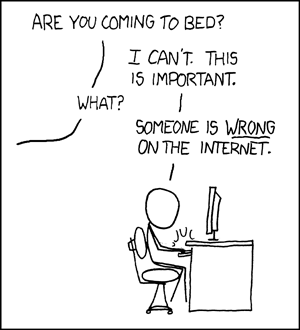
Duty Calls
Image courtesy of xkcd


Well, this is probably old news by now, but a storm has been brewing between a couple of my favorite feminist blogs - and a third blog which I'd never read before now. And which I won't be reading again, just for the record.

See, it all started when Feministe posted a link to an article about Call-out culture and how it actually damages online conversations between social activists. The original article is erudite and lovely and really, really long-winded. If, like me, you suddenly remembered you're teaching a more-than-full-time course load, while applying to 10 PhD programs, you probably want to read Feministe's recap of the article. And, like me, you'll probably be substituting three brownies and a vitamin B tablet for today's exercise quota. Brilliant, I know.

If even Feministe's recap is too much (and I'd understand), the basic gist is this: some activist bloggers make their name off of anonymously calling out other activist bloggers (who often have no idea they've been called out) and criticising them for some "problematic" slip up. The use of the term "problematic" is of special concern to the article's author, who sees it as a liberal elitist way of getting passive aggressive. Why the passive aggression? Well, the author suggests that some of these outraged anonymous caller-outers are themselves auditioning to fill the spots of those they depose. Problematic, indeed.

So, anyway, after I read over Feministe's article and skimmed the original, I found myself at once thinking, "Yeah, Womanist Musings! Time to stop hypocritically calling out other blogs for things you do too!" only to immediately recognize my own hypocrisy. Only to realize I still hadn't changed my mind about my love-hate relationship with Womanist Musings. And while I thought about blogging that guilt last week, perhaps nothing would have come of it if I hadn't then encountered another feministe post about a disagreement between Twisty at I Blame the Patriarchy and Holly at a blog that I'll only link after giving you due warning. The name of the blog is The Pervocracy, and while the post I'm about to link is PG-13, the rest of the blog gets so racy that after reading one racy post, I have no intention of reading her blog ever again. That being said, you can read the original post here or just Feministe's discussion of it here. Again, I'll provide the reader's digest version: Twisty has criticized Sex Positive feminists like Holly for what she perceives as capitulating to male fantasies and objectification of women. Holly has retaliated by arguing that Twisty not only misunderstands her, but that Twisty is in fact perpetuating sexist attitudes by what Holly refers to as "slut-shaming" sexy women.

Feministe, as a third party blog, manages to keep a pretty level head about the whole thing and remain relatively objective, but then Twisty heard about The Pervocracy's recent article and responded (reader beware, Twisty loves her F-bombs almost as much as she loves her horses). I can't say I blame Twisty, particularly when Holly links to her own former column, "Twisty Faster is ******* Insane" (censorship added), but it doesn't bode well when feminists start fighting each other.