Thursday, October 13, 2011
The Sexuality of Hair: A Guest Post from Aimee
Wednesday, October 12, 2011
News that makes Erica mad
Unless, of course, you're in Topeka, in which case you get a giant middle finger. Metaphorically, that is, although I'm sure there will be literal cases of flipping off too.
What's the issue, you ask? In essence, the city has voted to repeal its misdemeanor domestic battery law in favour of forcing the state to prosecute partner abuse cases instead. The decision came about as a result of cuts to the budget for the county district attorney, which resulted in the DA choosing to cease prosecution of partner abuse cases under state law and let the city handle them under city law. So when the city chooses to repeal its law making partner abuse a misdemeanor, what happens then? Theoretically, the county prosecutor picks the cases right back up again, although I'm still trying to figure out how the ending of the city law magically restores the funding to the county prosecution budget and thus ends the whole fiasco. If no magic wand does the job, though, then we're looking at a very real possibility that the DA won't be able to pick up the slack and keep people safe from their abusers. Already, offenders are being turned loose in some sick version of catch and release.
It all boils down to a giant fucking game of chicken, and I'm very worried that it's going to get someone killed.
Wanted:
“Wanted: interesting, generous man who loves to travel and make-out in dimly-lit bamboo forest. Nice shoulders a plus, but not required.” (We’ll come back to this).
Kate Bolick is an editor for Veranda magazine and she recently wrote an article, which, in it’s most reduced form, discusses the current women’s situation in the United States. However, the article really covers feminism, patriarchy, the current situation of men in the United States, sex, education, economy, history, racism, marriage, alternative forms of relationships and I think even gorillas were mentioned at one point.
Basically, it’s a big, long article (give yourself a good hour to really read it) and it’s worth it to read the whole thing—the article ends differently than I expected.
Because the article covers so much material, let me just say that there are a few things in the article I disagreed with, please feel free to do the same. Regardless of my caveat though, the piece is filled with interesting information about where women have started, and where we are now. She specifically focuses on the idea of marriage and how living in a nation where women have now become the more educated gender (55% of college students are women, but feel free to dispute that statistic) changes the sexual relationships between men and women. Many women are now marrying men who not as educated as they are, or are not marrying at all because men no longer need to marry to find willing sexual partners.
Bolick interviews several young, single women, all of which have had extensive sexual experience, but few committed relationships. Each one of the women felt that sex, for them, had been less about intimacy and more about the sex itself. This phenomena arises from the fact that there are currently loads of beautiful, educated women running around, and not as many attractive, educated, single men, meaning that of course, men can therefore have multiple sexual partners, without the need to commit. In one of my favorite lines of the article, Bolick states, "For centuries, women’s sexuality was repressed by a patriarchal marriage system; now what could be an era of heady carnal delights is stifled by a new form of male entitlement, this one fueled by demographics." Women’s sexuality was repressed by a “patriarchal marriage system,” however women are still unable to have fulfilling sexual relationships, though for different reasons.
So, she ends up discussing the ideas of love that we have perpetuated in our society; according to Bolick, the need for coupling is one that might actually diminish the value of other relationships. Often, people focus so much of their energy on the development of their romantic relationship that they do not have the time or the desire to continue to build friendships and familial and community support groups.
Now, I do not think that Bolick is arguing against marriage, but rather, merely exploring the consequences of such a narrow-focus for our society, and in that exploration she discusses the idea of women developing bonded, communities of love, while being single.
I think the idea is an interesting one, too often we pity those that are not part of a stable, paired relationship, especially within many conservative, Christian cultures, (of which I am a part being LDS). Our society perpetuates this view with HUNDREDS of films, known as romantic comedies, that show lonely, quirky, silly, slightly pathetic women, desperately searching for a good man (Bolick argues that current trends have literally made fewer “good men,” do with that what you will). However, always in these movies that quirky, cute, Kate Hudson manages to find and win the heart of a legitimate hunk—rarely, do such movies discuss the possibility of not finding someone to share your life with (exceptions such as, My Best Friends Wedding, Annie Hall, and 500 Days of Summer are rare).
My second favorite line by Bolick offers an excellent viewpoint on this topic, "the single woman is very rarely seen for who she is—whatever that might be—by others, or even by the single woman herself, so thoroughly do most of us internalize the stigmas that surround our status. " Too often do educated, beautiful, interesting and unique women feel the sting to their self-esteem that comes from their marital status. The world has, unfortunately, always defined a woman's worth by her ability to get married, not by her ability to contribute in other ways or have valuable relationships outside of marriage.
In typical double-standard fashion, the world doesn’t seem to care as much about it’s single men; it’s cool to be a Heffner bachelor, but sad to be an old cat lady (again, there are certain cultures that do place pressure to get married on their single male population as well).
Our society should find a little more value in it’s single women (and men); not only do we have a lot to offer the world, but we have a lot to offer to other single women. To that end, Bolick finishes her article on the incredibly positive note of female bonding. Single women have been supporting each other, building creative artistic communities and caring for one another for thousands of years: convents and boarding houses become an example for such powerful, and historical, relationships.
This past weekend I was able to visit a lantern festival in Jinju, South Korea with my friend Sarah. It was incredible; lanterns everywhere on a giant river—gorgeous. Of course, the festival was easily a romantic one, fireworks, lantern tunnels, there was even a lovers lane constructed in a small bamboo forest near the river which had lanterns in the shape of copulating bugs (seriously, I’m including a picture for proof). At one point, while sitting on the river, waiting for the fireworks to start, I remember thinking how much I would like to go back to the festival someday with my husband, boyfriend, lover. You know, “Wanted: interesing, generous man who loves to travel and make-out in dimly-lit bamboo forest. Nice forearms a plus, but not required.” But after reading Bolick’s article, I sort of rethought that idea. Maybe my want ad should instead be, “Wanted: one traveling companion and friend. Enjoyment of good food and cheap hotels a must.” And I had that. I had a great time with Sarah, we talked politics, religion, traveling, feminism, relationships, teaching and loads of other topics, basically, female bonding a la bus.
As women, we should happily see ourselves as just that, women. This is something that I think feminism has given us, the right to view ourselves outside of the realm of wife and mother. The single, the individual, is never alone, we are instead, full to the brim with powerful, varied relationships, education, and ideas (and in my case, all sorts of feminist angst).
** Thank (insert deity here) for awesome principals that give tired English teachers an entire week off of work so we (meaning me) can lay (lie?) in bed and catch up on some feminist blog reading (and facebook). Because of such a day I was able to read this article and get all sorts of interested and excited. On a quick sidenote, can I just say how grateful I am for the internet and the unique minds of writers, artists and thinkers who post wonderful and provocative content each and everyday? Here’s a shout out to all you conscientious people with great internet surfing skills.
Tuesday, October 11, 2011
News that Makes Emily Mad
Sunday, October 9, 2011
Crosshairs of Cultural Sexism
Where do the cross hairs of culture and blatant sexism lie? When does tolerance end and sticking your head in the sand begin? Questions for the ages I know; I realize that people have been trying to answer this question for years—inside and out of academia.
It’s not just a question for academics and Stanley Fish (we’ll come back to him later) rather it’s a practical question that has a daily bearing on our lives. Personally, I feel very close to this issue right now as I’m currently living in South Korea for a year teaching English. First things first, I’m loving South Korea (just in case you wanted to know) the food is excellent and the people are really nice, especially to foreigners, it’s easy to see that they’re excited to have us in their country (hence a small amount of guilt for this post, but I still feel like it needs to be said). Needless to say, you’ll probably be hearing a lot about South Korea from me over the next year.
However, South Korea, like many Asian countries, is still based on a patriarchal system. While things are getting better for women out here, there is still a lot of repression going on. Women rarely hold positions of power, the way women look is intensely important (femininity is key) and men are DEFINITELY still seen as the head of the household. Here is an example, this is sort of an odd story, but I think it helps to show my point: a few friends of mine, one man and two women, were in a taxi (a gloriously cheap mode of transportation here) and they needed some information off the man’s cellphone to give to the taxi driver. The man tried to hand it back to one of the two women with him since one of the women knew how to get the information. The taxi driver protested, he kept insisting that the man not give the cellphone to the woman, for some reason, this taxi driver felt that the man should have the information, should find it, and should be the one to communicate with him.
Seems small and silly, right? But this drives me crazy! That a woman should not be able to access information because a man is in the room and could find it better is pretty blatant, early sexism.
Similarly, I was attending church one Sunday and during many of the lessons I’ve been told that it is a man’s job to provide for his family and that a man should be a wise father and a woman should be a loving mother (since this augments their divine characteristics). Men should make sure to spend time alone with their children so that they can better instruct them in the ways of patience and wisdom. One man told a story about feeling like he needed to sell his house and so he told his wife to put the house on the market and since she’s OBEDIENT (translators exact words) she did it.
Now, I just usually sit there and smile and nod, because, well I’m a guest in their country. These people have been nice and generous to me, offering rides and help with whatever I may need. Similarly, this is a part of their culture, a culture that has been around for thousands of years. As westerners, we believe that the diversity stemming from other cultures is a positive thing; we value tolerance and understanding and the preservation of those cultures.
So this is my dilemma for the day, how do we, as feminists (and therefore implicitly humanists) handle these kinds of situations? Should I politely start to point out to the Korean women and men that I interact with that maybe some of their ideas about women and society aren’t entirely appropriate? Do I merely set an example of independence and feminism (but is that enough)? Do I pass out copies of the feminine mystique as Christmas presents? Or do I continue to bite my tongue and nod at doctrines and attitudes that I personally believe to be destructive and damaging?
Now, in regards to the “big” stuff, I definitely think we should be pushy; child brides in India and the abuse of women in Iraq, Afghanistan (and other countries) should definitely be eradicated, but what about the small, cultural stuff? It’s still not good, but these women are loved by their husbands and if they decide to drive no one will beat them up when they get home.
I don’t want to be the pushy Western imperialist and gleefully romp all over someone’s country and culture, that just doesn’t seem right, but neither do I want to be a party to the continued repression of my fellow sisters.
Stanley Fish once stated that, in reality, we are all only “boutique multiculturalists,” meaning of course that we profess to love and accept other cultures, but that eventually we encounter something we can not support; obviously in that moment we’re no longer truly multiculturalists.
Honestly, I have to believe that Stanley Fish might be right, I feel like I can’t support the behaviors of repression (or oppression as the case may be) no matter the long-standing cultural beliefs they come out of or even the apparent silliness of the example (i.e. the taxi story).
Therefore, I am your intolerant imperialist signing off…..
Tuesday, October 4, 2011
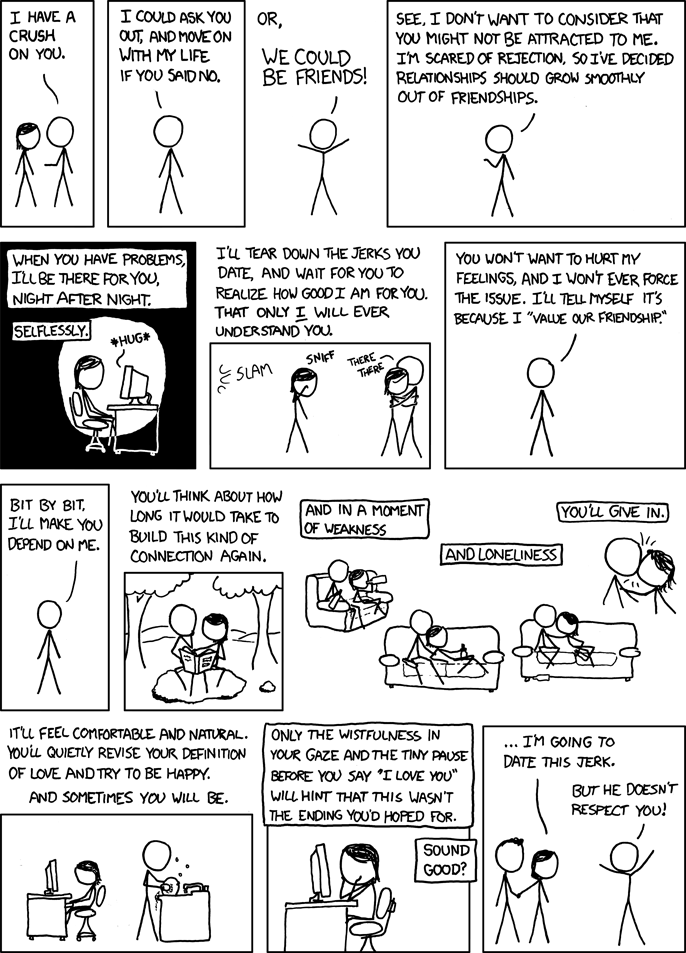
Ask a Feminist: XKCD and the Nice Guy Conundrum
![]() |
| Image courtesy of xkcd |
This post is our first installment in a new column, "Ask a Feminist," which will be published every 1st and 3rd Tuesday.
Brennan:
I read a bit of your feminism blog, and now I am intensely interested in what you think of this comic. I'm curious what you think the message is that this artist is trying to portray, whether you agree with it, and what you would say instead (if anything.) It might also give you fodder for another blog post.
I'm pretty sure I disagree with the message of this comic, but I'm not sure if I'm interpreting it correctly, or if there even is a single interpretation. If you'd like, I'd be happy to explain what I think it's trying to say and what I believe instead, but I'd rather you have a fresh view of it first.
Emily:
I've seen this comic before (I love xkcd), so I might not have the freshest perspective. But I think there are a couple jokes at play here - there's obviously the stereotype of women going for jerks instead of the nice guy best friend who's always there to support them, but the joke in the end is that the "nice guy" doesn't respect her either, because rather than risk rejection he's hoping to catch her in a moment of weakness and be with someone who's unhappy to be with him. The other joke, of course, is that she openly decides to date a jerk at the end, which suggests women really do prefer jerks. I can't say I agree with that message, but I would agree with the message that it's equally disrespectful to try to manipulate a person rather than risk rejection.
How are you reading it?
Brennan:
Well, I read on a (Non-LDS) feminism site about two years ago the rant of a woman who insisted that she hated the "nice guys." She said that in her opinion, any male who was obviously interested in her and refused to admit it was guilty of playing the "Nice Guy" con, and linked to this comic to explain what exactly that con consisted of. She insisted that being friends with a girl when you were actually interested in her was inherently dishonest.
I'm especially interested in the second and third to last panels, where he hints that the marriage of two friends would be sub-optimal, and implies that something would be missing from the relationship that would have been there if he'd have been a "jerk" instead. However, this "missing something" is never fully explained. It's almost as though it is just assumed the reader knows what it is and agrees.
I personally think that a truly valuable relationship comes as a result of two best friends deciding to be something more. I have never understood why people go from hardly knowing each other to being in a relationship. In my mind, the progression has always been pretty straightforward: You become interested in a girl, you befriend that girl so you get to know her in a variety of situations, and if, after getting to know her, you're still interested in her, you broach the subject of a relationship and see where it goes. To imply that a previous friendship is a detriment to "real relationships" confuses and disturbs me.
In a way, it's an extension of the "nice guys finish last" aphorism, which I've read many times as I've done research on how the world at large views relationships, which I still have a hard time swallowing, and which I think might say more about the "average, worldly woman" than it does about the kind of relationship God would want between two of his children. I figured any girl who didn't want a nice guy was just disqualifying herself as being "not my type." The added complication of nice guys being viewed by this author as inherently untrustworthy is somewhat alarming, and I hope this isn't the view of the world at large.
Emily:
I'd be cautious to assume the author of xkcd views nice guys this way, but I can understand your concern, since movies, books, and television are so quick to portray "nice guys" as boring. But this problem isn't as one-sided as popular American culture would have us believe. Along with the woman who ignores the kind boy next door and instead goes for some jerk who uses her, there are plenty of men who do the same thing. I had a female friend who took great pride in her ability to control men. How did she do it? She treated them like dirt, and they'd usually come crawling to her.
Another misconception about the Bad Boy Mystique (if that term isn't already out there, I'm copyrighting it here and now!) is that women want men who openly treat them like dirt. However, having dated a
So, while I can't comment on what this feminist blogger said, I can see why she might see any form of deception as a sign of trouble. If a man is only friends with a woman because he has an ulterior motive, that's hardly the foundation of a solid relationship. Also, I've witnessed friends crumble after a man who spent tons of time with them and acted like a boyfriend, for an extended period of time but without committing, eventually decided to date someone else. Perhaps that's part of what that blogger was concerned about? Still, I don't think we should preclude the possibility that a man wants to develop a friendship with a woman and also get to know her better, with the potential for romance in the back of his mind.
Monday, October 3, 2011
Question of the Week: Do You Call Yourself a Feminist?
So, with all the opposition to the term "feminist" that really is out there, here's my question for you, dear readers:
Do you call yourself a feminist? Why or why not?